
 Apply For a Mortgage
Published: September 22nd, 2026 • Last Updated: September 25th, 2026
Author: Ross Taylor on AskRoss.ca
Why Your Fixed Rate Went Up While the Bank of Canada Sat Still
The Federal Reserve raised its policy rate on September 16th. It was the first American rate increase in more than three years.
On September 2nd, the Bank of Canada held its policy rate at 2.25% for the seventh straight decision.
So Canadian mortgage rates should be sitting still too, right?
That’s a reasonable assumption, but unfortunately the wrong one.
Canadian lenders have been raising fixed mortgage rates for weeks, with no help at all from the Bank of Canada. I’ve been fielding this all month from clients coming up on a renewal who did everything right and still got a worse number than they were promised in the spring.
The rate you’re quoted on a five-year fixed is set in the global bond market, and the Bank of Canada is a spectator.
Jump to a specific section in this article ↓↓
- What actually sets your fixed mortgage rate in Canada?
- How does a decision in Washington reach a mortgage in Ontario?
- Why is the Bank of Canada holding while the Fed is hiking?
- Can the Bank of Canada keep drifting this far from the Fed?
- What does a Fed hike mean for your mortgage renewal?
- Should you go fixed or variable when the next Canadian move might be up?
- How do rising fixed rates change what you can qualify for?
- Advice from Ross Taylor Mortgages: Making Rate Decisions in a Global Market
- List of all FAQs: U.S. interest rates and Canadian mortgage rates
What actually sets your fixed mortgage rate in Canada?
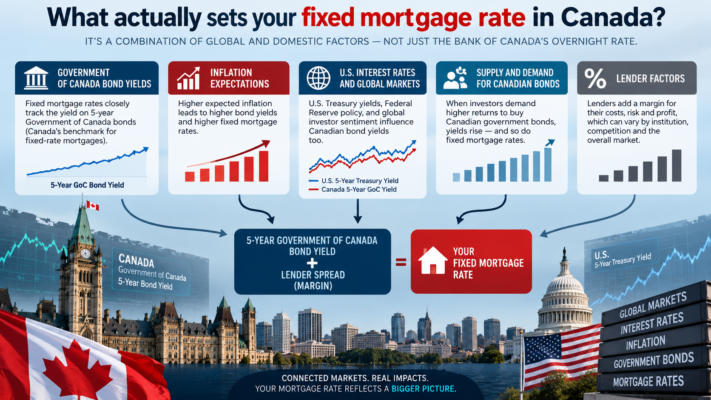
Your five-year fixed rate is primarily priced off the five-year Government of Canada bond yield, plus a markup your lender adds on top. The Bank of Canada’s overnight rate is not an input to that formula.
The overnight rate matters enormously for your variable mortgage and your line of credit. Bond traders do watch it, but they trade on where they think it’s heading.
Which rate should you actually be watching?
A government bond is a loan, and the yield is the interest on it
- When Canada needs money, it borrows by selling bonds to investors. The yield is what those investors charge for the loan, and it moves every day like a share price.
- Your lender has to compete with that number. Nobody lends for five years at 3% when the government is paying 3.6% for the same five years, so the government’s yield becomes the floor under your mortgage rate.
Your lender’s cut sits on top, and right now it is thin
- That five-year yield has gone from 2.72% in late February to roughly 3.6% today. On a $500,000 mortgage, a climb that size is worth a few hundred dollars a month.
- Lenders normally add 1% to 2% on top of the yield. That covers their costs, their risk and the competition. Today it’s down to about 0.8%, so the next jump in yields lands on you instead of being absorbed.
The overnight rate controls your variable mortgage
- The overnight rate is the one you see in the headlines. The Bank of Canada sets it, prime follows it, and your variable rate is quoted as a discount off prime. With the policy rate at 2.25%, prime sits at 4.45%.
- So when the Bank holds, variable borrowers really are fine. If you read the September announcement, your payment is exactly where it was in August.
Lenders raise fast and lower slowly
- A real jump in yields hits rate sheets within days. Coming back down takes far longer, because lenders protect their funding costs on the way up and take their time passing relief back.
- Published rates rose 0.10% to 0.20%, and real quotes rose by more. Lenders also pulled the discounts their staff were allowed to offer, so a 0.20% published increase reached some borrowers as 0.40%. The advertised number moved once, and yours moved twice.
Not sure what your rate should be today? Call us at 416-989-1000, and we’ll tell you what lenders are actually paying out this week.
↑↑ Back to the list at the top ↑↑
How does a decision in Washington reach a mortgage in Ontario?
Canada and the United States borrow from the same investors, so when America has to pay more, we pay more. Neither central bank gets a vote in that.
American borrowing costs just hit a level they haven’t seen in almost twenty years, and Canadian yields were pulled up behind them. The same thing is happening in bond markets around the world.
What did the Fed’s September hike actually do to Canadian rates?
- Big investors choose between Canadian and American government bonds every day. If America starts paying more, Canada has to pay more too, or the money goes south.
- The American 10-year Treasury is the benchmark the whole world prices off, and it just went to 5%. It closed at 5.01% on the day of the Fed decision. When the world’s benchmark resets that high, Canadian fixed rates reset with it.
- Our yields followed, the way they have all year. Between late February and late August ours rose from 2.72% to 3.28% while the American 10-year went from 4% to 4.71%.
- This isn’t only a Canada story. Japanese yields climbed over the same stretch and crude sits above $100, so investors everywhere are charging governments more to borrow.
If your renewal lands in the next twelve months, email us at [email protected] and we’ll show you how exposed your timing is.
↑↑ Back to the list at the top ↑↑
Why is the Bank of Canada holding while the Fed is hiking?
Our inflation looks worse than it is. The headline number is 3%, but take gas out of it, and the rest is running at 2.4%, which is close to where the Bank wants it.
Meanwhile, our economy is limping under tariffs. So the Bank has sat still seven times in a row, even as the Fed went the other way.
Does the Bank of Canada have to follow the Fed?
- No, and it has said no seven times in a row. The September 2nd decision was the seventh consecutive hold, which leaves our rate 1.5% to 1.75% below the American range of 3.75% to 4.00%.
- Gas is up 22.8% in a year, and that’s what you’re seeing in the headline. Inflation held at 3.0% in August, while the Bank’s core measures, which leave out the wild swingers, sat at 2.0% and 1.9%.
- We also have a growth problem the Americans don’t have. Tariffs on our exports and our own counter-tariffs are dragging on this economy, and higher rates would slow it down further.
- The Bank has now warned it might have to hike anyway. Its governing council agreed that if high energy costs start bleeding into other prices, a policy response may be needed. That warning is new.
Holding out for a cut before you commit? Call us at 416-989-1000, and we’ll walk through exactly what you’d be waiting on.
↑↑ Back to the list at the top ↑↑
Can the Bank of Canada keep drifting this far from the Fed?
Oil usually props our dollar up, but it hasn’t been enough this time. If oil falls too, the Bank may be forced to raise rates, which would move your variable rate.
What would actually force the Bank of Canada’s hand?
- A weak loonie makes everything we buy from the States cost more; pricier imports push up inflation, and inflation is the one thing that forces the Bank to raise rates.
- Normally, a rate gap this wide would sink our dollar. Money chases the better return, so with America paying more, the loonie should be falling. It hasn’t been.
- Oil is the reason. Canada sells oil, oil is above $100, and that has held the loonie between roughly 71 and 73 cents US all year. That’s what has let the Bank hold while the Fed hikes.
- If oil drops while the Fed keeps hiking, that protection disappears. Our dollar loses its support at the same moment the rate gap widens. That’s the scenario that puts a Canadian hike on the table.
On a variable and wondering what one more hike does to you? Email [email protected], and we’ll run your actual payment, not an example.
↑↑ Back to the list at the top ↑↑
What does a Fed hike mean for your mortgage renewal?
If you signed in 2020 or 2021, your renewal is the biggest money event of your year. A five-year fixed taken back then was frequently under 2%.
The same term today sits just above 4%, and a Bank of Canada hold does nothing to soften that landing.
How much should you actually brace for?
- The last of the pandemic five-year fixed mortgages renew through the first half of 2027. The Bank of Canada puts that final group at about 12% of all Canadian mortgages, facing payments averaging 15% higher.
- Here is what that looks like in dollars. A $500,000 balance with 25 years left, moving from 1.89% to 4.49%, adds somewhere around $600 to $700 a month. That’s a car payment and a grocery bill arriving together.
- If you’re on a variable with a fixed payment, pull out your statement. Your payment never moved, but more of it has been going to interest, so some people have barely dented what they owe. The Bank expects about one in ten of them to face an increase of more than 40%.
- Shopping around no longer puts your approval at risk. You don’t have to re-qualify to renew as is with your current lender, and since late 2024, a straight switch to a new federally regulated lender is also exempt, provided you don’t borrow more or stretch the amortization. You’re not re-taking the stress test, though the new lender still has to approve you.
Send us your maturity date at [email protected], and we’ll start shopping your renewal before your bank sends its offer.
↑↑ Back to the list at the top ↑↑
Should you go fixed or variable when the next Canadian move might be up?
Fixed versus variable is the decision I spend most of my time on, and the honest answer has changed since the spring.
For two years, choosing variable meant betting on cuts that nearly everyone expected. Those cuts are gone from the forecast.
How do the actual numbers compare right now?
Variable is cheaper today, but you are paying for that later
- The best five-year fixed is around 4.39%, and the best variable is near 3.40%. On a $500,000 mortgage over 25 years, that’s roughly $267 a month staying in your pocket.
- You keep most of that even if rates climb. The gap is 0.99%, so one quarter-point hike trims it to 0.74%, a second to 0.49%, a third to 0.24%. You’re being paid to take that risk, not handed a discount.
Shorter fixed terms are now the cheapest fixed money
- Three-year fixed now sits below five-year at most lenders, often by a quarter point or more. That reverses the pattern of the last four years, when short terms were the expensive ones.
- Locking five years at the top of a spike carries its own risk. If the conflict cools, oil falls, and yields come back down, and you carry today’s pricing until 2031.
Your budget settles this argument better than any forecast
- Fixed isn’t really a rate; it’s a budget. You’re paying a premium to know the number.
- Try this before you decide. Take your current payment, add 20%, and live on that number for two months. If it hurts, you have your answer.
Want those numbers run against your actual balance? Book a call, and we’ll show you the monthly difference instead of describing it.
↑↑ Back to the list at the top ↑↑
How do rising fixed rates change what you can qualify for?
A higher rate doesn’t just raise your payment; it shrinks the mortgage you’re allowed to have. Most buyers never see that second part coming.
The stress test is the rule that decides how much a lender will approve. It climbs every time your rate does.
How does the stress test respond to rising rates?
- You have to prove you could afford your rate plus 2%. That OSFI rule hasn’t changed, so at a 4.39% contract rate you’re tested at 6.39%, not at the rate you’ll actually pay.
- Every quarter point costs you about 2% of your maximum mortgage. A household approved for $450,000 loses roughly $9,000 of buying power. Our affordability calculator runs off the qualifying rate, so it shows you what a lender will actually approve.
Want the number a lender will put in writing? Call us at 416-989-1000 and we’ll pre-qualify you properly before you start looking.
↑↑ Back to the list at the top ↑↑

Advice from Ross Taylor Mortgages: Making Rate Decisions in a Global Market
The question I get asked most right now is whether to wait. It’s the right question, and the answer has changed since the spring.
Waiting for cuts is the strategy I’d retire first. I’m not telling you to panic, and I’m not telling you to rush, only that the case for waiting has gotten weaker.
What should you do in the next thirty days?
- Plan around the rate in front of you, not the one you’re hoping for. Your renewal date is real, and four of the Big Six banks now expect the Bank of Canada’s next move to be up, with RBC forecasting 3.25% by the end of 2027.
- Get a rate hold the moment your lender’s window opens. It costs you nothing, and most run 90 to 120 days. Ask what happens if rates drop before closing, because some lenders hand you the lower rate and some won’t.
- Ask your broker what the five-year bond yield did this week. If they can’t tell you, they’re quoting rates without understanding what sets them.
- Start your renewal conversation six months out, not six weeks. The letter your bank mails you is an opening offer, and it’s rarely the best rate that lender has available.
If you’re renewing, buying, or just trying to make sense of the letter your lender sent you, reach out. We’ll walk you through all of your options.
↑↑ Back to the list at the top ↑↑

List of all FAQs: U.S. interest rates and Canadian mortgage rates
What actually sets your fixed mortgage rate in Canada?
- The five-year Government of Canada bond yield, which is what investors charge to lend the government money, plus your lender’s cut of 1% to 2%. The Bank of Canada’s rate sets prime, which drives your variable rate, but it plays no part in fixed pricing.
How does a decision in Washington reach a mortgage in Ontario?
- Canada and the United States borrow from the same global investors, so our bond yields move together. When American yields rise, ours follow, and Canadian lenders raise fixed rates within days.
Why is the Bank of Canada holding while the Fed is hiking?
- Because most of our inflation is gasoline. Take gas out and inflation sat at 2.4% in August, and Canada is also dealing with a tariff-driven growth problem the Americans don’t have.
Can the Bank of Canada keep drifting this far from the Fed?
- For now yes, because high oil prices have propped up the Canadian dollar. If oil falls while the Fed keeps hiking, our dollar drops, imports get more expensive, and that becomes a real argument for a Canadian hike.
What does a Fed hike mean for your mortgage renewal?
- The last of the pandemic five-year fixed mortgages renew through the first half of 2027, at payments averaging 15% higher. A $500,000 balance with 25 years left, renewing from 1.89% to 4.49%, costs roughly $600 to $700 more per month.
Should you go fixed or variable when the next Canadian move might be up?
- Variable is about one percentage point cheaper today, but the market now expects the Bank’s next move to be up rather than down. If a one-point increase would strain your budget, take the fixed and price out a three-year term.
How do rising fixed rates change what you can qualify for?
- You have to qualify at your contract rate plus 2%, so at 4.39% you’re tested at 6.39%. Every quarter point trims roughly 2% off your maximum mortgage, which is about $9,000 on a $450,000 approval.
Will my variable rate go up because the Fed raised rates?
- Not directly, because your variable rate only moves when the Bank of Canada moves. The indirect risk is real but slower, running through a weaker dollar and more expensive imports.
Should I lock in my mortgage rate now or wait for rates to fall?
- Get a rate hold either way, because it costs nothing and most run 90 to 120 days. Waiting purely for cuts is a weaker bet than it was a year ago, since neither the bond market nor the Bank is pointing down.
Why is the mortgage rate I was quoted higher than the one advertised online?
- Lenders pulled their discretionary discounts at the same time they raised published rates, so a 0.20% advertised increase reached some borrowers as 0.40%. Comparing several lenders is worth more right now than it usually is.
Will the Bank of Canada raise interest rates in October?
- Most economists still expect a hold on October 28th, pointing to slow third-quarter growth and core inflation near target. Traders put roughly two-in-three odds on a hike before the end of the year.
Do I have to pass the stress test when I renew my mortgage?
- Not if you renew as is with your existing lender. Since late 2024 a straight switch to a new federally regulated lender is also exempt, as long as you don’t increase the balance or extend the amortization.
Why are three-year fixed rates cheaper than five-year right now?
- Because lending money for longer costs more again, the way it normally should. That reverses the pattern of the last few years, when short terms were the expensive ones.
↑↑ Back to the list at the top ↑↑

Ross Taylor Mortgages
If you want great service from someone you can trust – reach out to us today.
Get quick answers to your questions, no matter how difficult – 7 days a week.